Which details should a Boondall homeowner report when a plumbing problem needs assessment? Is the problem confined to one fixture, or are several affected? Is water escaping now, and what should be said about timing and cost? Start with a description of what is happening, rather than a guess about the failed part.
For someone looking for a plumber in Boondall, the seven categories below provide a way to organise that description. They are reporting categories, rather than a ranking of local faults or a diagnosis. For each problem, record the location, what has been observed, when it began and any steps already taken. Ask the provider to explain urgency, proposed work and charges before agreeing to a visit.
1. A drain that will not clear
Describe the affected fixture precisely: the kitchen sink, shower, laundry tub or another outlet. Then distinguish between water that drains slowly and water that remains in place. Avoid naming an obstruction or its location without an assessment.
A useful observation checklist is:
- Which fixtures are affected?
- Does the problem happen every time that fixture is used?
- Has anything changed since it was first noticed?
For a hypothetical example, a homeowner might report: “The kitchen sink has drained slowly since yesterday, but no problem has been noticed at the shower.” That describes the observation without claiming where a blockage sits. If other fixtures have not been checked, say that rather than reporting them as unaffected.
2. A toilet that will not clear
Keep the description specific to the toilet before adding observations elsewhere. Does the bowl remain full, does its level change, or is water visible on the floor? Record what has already happened rather than repeatedly operating the fixture to produce a more detailed report.
Separate an observed symptom from an assumed cause. “The bowl level rose after the last flush” describes an event. “The main sewer is blocked” names a diagnosis. Use the first kind of wording and ask what further information is needed to assess the situation.
If a sink or shower also appears affected, include that as a separate observation. Do not assume the two problems share a cause.
3. An unexplained bathroom or drain smell
Describe where the smell is strongest and when it was first noticed. Is it near one fixture, throughout a room or somewhere outside? Note whether it is constant or appears at particular times.
Avoid turning “an unpleasant smell near the shower” into a confirmed sewage fault. Likewise, report any accompanying sound or visible water separately, without claiming that one explains the other.
A hypothetical report could read: “An unpleasant smell was first noticed beside the bathroom floor drain this morning. No overflow has been observed.” The wording leaves room for assessment while giving a definite location and starting point.
4. A leaking tap or fixture
Identify where water appears: at the spout, around the handle, underneath the basin or somewhere nearby. Describe whether it was noticed while the tap was running or after it had been turned off. Leave the component name open unless it has been established.
When describing a tap problem to a plumber, note which fixture is affected and where the leak is visible. The Bauer Books article on when to call an emergency plumber advises preparing the fault’s location and description, how long it has been present, and steps already taken. Include what happened after any action you attempted, while leaving the cause open unless it has been established.
Before authorising work, ask what the proposed assessment includes and how any additional repair work will be priced. Keep those questions separate from the description of the leak.
5. A suspected burst or split pipe
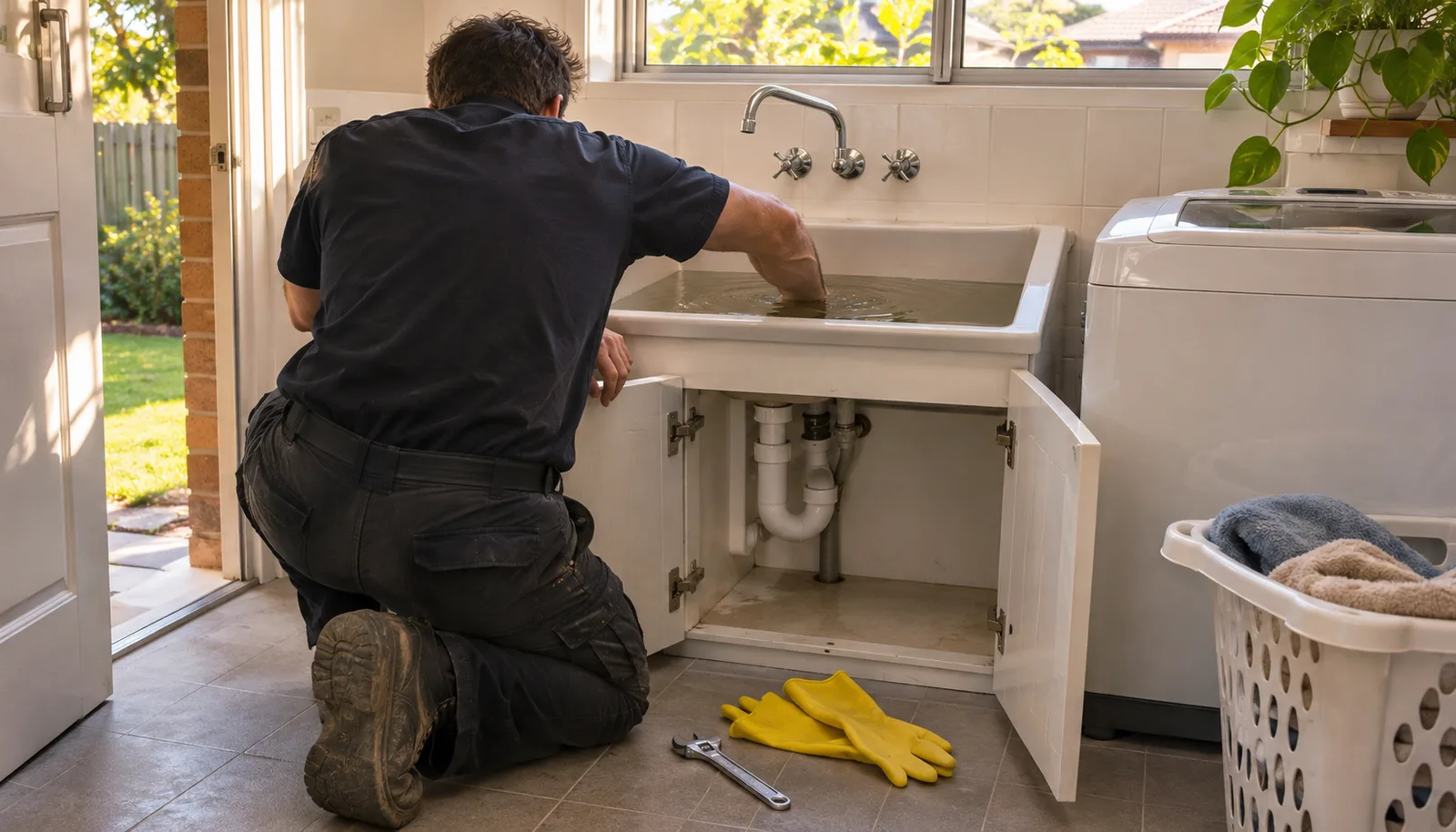
Use “suspected” when the pipe itself has not been inspected. Describe the visible event instead: water spraying from an exposed pipe, water appearing beside a wall, or a wet patch whose source is unknown.
State whether water is still escaping at the time of the report. If an existing valve has already been operated, identify it as accurately as possible and describe what changed. Do not describe the supply as isolated unless that has been established.
The practical question is what assessment and immediate instructions are appropriate for the conditions being reported. Ask that directly rather than deciding urgency from a guessed fault name.
6. Water pooling outside or overflowing near drainage
Record the location of the water and the conditions when it appeared. Was it noticed during rain, after rain or at another time? Distinguish a direct observation from an assumption about where the water came from.
For example, “Water collected beside the rear grate during yesterday’s rain” is a hypothetical observation. “Tree roots have blocked the stormwater pipe” adds a cause that has not been established.
Before discussing alterations, ask the provider to explain the proposed scope. Is the proposal an investigation, clearing work, a repair or a change to the existing arrangement? Request an explanation of what remains uncertain before approving that scope.
7. Missing hot water or a leak near the system
Separate the temperature complaint from any visible leak. Record which outlets have been checked and what was observed at each. If the system label is readable without handling equipment, include its details in the report.
Avoid selecting a replacement unit or naming a failed component from the symptom alone. Ask what assessment is proposed before discussing repair or replacement options. If water has also been noticed near the system, describe its exact location and whether it is still appearing.
Questions before approving the work
For questions about Queensland requirements, the government publishes the Plumbing and Drainage Act 2018. Ask the provider which requirements apply to the proposed job, including whether any approvals or documentation are needed, rather than assuming an answer from the fault category.
The Australian Building Codes Board describes the National Construction Code as Australia’s primary technical design and construction provisions for buildings. Ask which technical provisions, if any, apply to the work being proposed. Keep that question tied to the actual scope.
Before agreeing, read back the fault description and confirm the proposed next step, expected attendance timing and charges. What is being authorised now, and what would require a further decision?